


Breaking the Bottleneck in the Wireless Front-End
Wireless demand is exploding. From AI-powered devices and 8K streaming to multi-link mesh networks and low-latency XR, modern applications demand faster speeds, wider bandwidths, and radically improved power efficiency.
Wi-Fi now carries over 80% of global internet traffic. Standards like Wi-Fi 6E and 7 have risen to meet the challenge – expanding into new spectrum and unlocking higher throughput. But the underlying hardware hasn’t kept pace. The RF front end – responsible for signal amplification, filtering, and switching – has become the bottleneck. Instead of enabling the next-gen performance, it’s holding it back.
At QuantalRF, we’re changing that – with a new analog RF architecture built from the ground up for performance, efficiency, and scalability.
The Problem: Stalled Analog Innovation, Digital Workarounds at Its limits
Despite leaps in wireless standards, RF front-end efficiency has only improved less than 30% over the past 15 years. Analog innovation has stalled – replaced by digital correction schemes like DPD and thermal calibration.
To reduce costs, front-end vendors offloaded performance responsibility to the SoC, relying on digital patches to fix inherently analog problems. But these digital workarounds have reached their physical and architectural limits:
- Efficiency gains are capped below 18%, limited by GaAs HBT physics
- System complexity and integration risk continue to grow
- DSP power draw adds thermal and energy overhead
- Linearity suffers, and performance collapses under wideband signals like 320 MHz Wi-Fi 7
- No real breakthroughs—just cost-reduced iterations of legacy designs
Digital correction once extended performance. Today, it constrains it.

The Solution: A Smarter, Monolithic RF Architecture
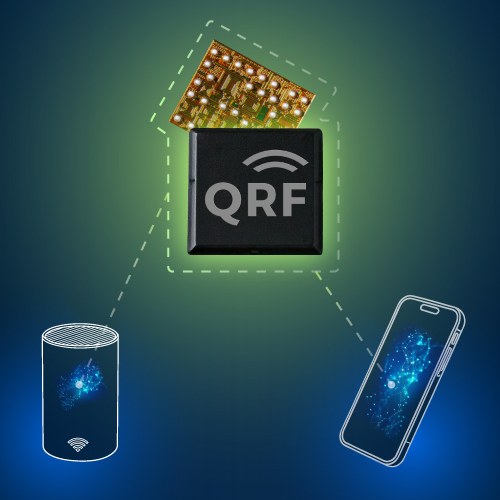
QuantalRF breaks from legacy constraints with the industry’s first truly monolithic front-end platform in standard CMOS-SOI. We’ve reimagined the RF front-end architecture from the basic first principles.
Our solution is combining PAs, LNAs, filtering, switching, and matching—traditionally split across multiple chips and materials—into one monolithic die. No compound material. No digital band-aids. Just smarter, cleaner signal performance.
Powered by our intelligent and adaptive multi-loop analog feedback system, the architecture self-optimizes in real time—boosting efficiency and linearity across all Wi-Fi modes and channel conditions.
Data-Driven RF. Smarter by Design.
This isn’t old-school analog – it’s adaptive, intelligent analog architecture powered in real-world data.
QuantalRF’s architecture learns from real silicon, using billions of measured conditions to train ML models that optimize performance in the field and drive continuous IP improvement. We don’t simulate. We measure, learn, adapt and deploy faster with every generation.
Performance That Raises the Bar
- Self-correcting and fully autonomous, real-time performance tuning
- Real-time distortion cancellation enabling true Wi-Fi 7 performance at 160–320 MHz channels
- 2× efficiency vs. leading GaAs/SiGe FEMs
- Consistent <–45 dB DEVM across bandwidth, temperature, and packet length
- No digital correction or DSP dependency


Faster to Market, Integration Without Complication
QuantalRF simplifies wireless system design while raising performance:
- Fewer chips, lower BOM
- No software tuning, no digital calibration
- Compact designs with cooler operation
- Faster time-to-market at lower system cost
Unlocking the Wireless Future
QuantalRF isn’t following the wireless evolution—we’re defining its next frontier: from Wi-Fi 8 to 6G, from smartphones to space.
We’ve broken past legacy RF limits to enable wireless systems that scale with the future—smarter, cooler, scalable, and radically more efficient.
This is the new benchmark for RF front-ends—designed in silicon, proven in systems and in the field. Ready for future.